Tuesday, August 23, 2022

Intel Decide

My laptop is so old that its camera needs a cataract removal the day-before-yesterday – that’s how urgent it is, not bad English as you have possibly surmised (having read earlier posts of mine with restrained tolerance).  

The sound emanating from it - the laptop, not my English - resembles a rasping cough of someone with a permanently fossilized tonsil that has merged with a free-floating collar bone.  And when I key a few words in, I go off, have a cup of tea and return in time to be informed that there was an error by an idiot at the other end of the keyboard.  The battery, of course, popped off long ago, which, if you did not know, is the second fastest known way to convert a laptop into a desktop (the fastest is to use Fevicol on the desk.  Is jod ka koi tod nahi. End of sponsored feature).

So, you are asking, what prevents me from buying another laptop?  Well, I don’t know if you are similar in this respect, but choices confuse the hell out of me.  After much hemming, hawing and hanging (not me, as you guess, but the old laptop), I decided to buy one.  This decision did not do much for the stock price of HP or Dell, of course, but I did get the distinct feeling that I was contributing to the World Economy In A Time Of Need.

 Everybody will tell you that there’s only one thing that matters in this decision: the choice of chip or processor, whatever that thing is.  I knew right away that it had to be Intel because there’s a good friend who works there and one always needs to know whom to abuse with those four words I learnt in Khan Market in Delhi, so that was sorted (he doesn’t know yet, so keep it to yourself). 

Once you decide that it’s Intel, you have a choice of

a) 11th generation of Intel Core i5 or
b) 14th gen of i3 or
c) 7th gen of i7 or
d) the uncle-in-law of the 19th gen of i-something (which would make it 18th bloody gen)
..and on and on.

And I am just beginning.  There are heaps of generations of heaps of i-whatever-odd-number. A vital tip: if you plan to check with google chacha about which is superior to which, there are two periods of any day that you should not choose: before 11 am and after 11 am.   Because you instantly feel like a congenital condemned genetically-one-chromosome-missing dud. There is nothing – zilch, shunya, nil, el cero, naught, cipher, laddu - online that can tell a human being (not a techie.  The two species are mutually exclusive) anything useful; using geek-talk that reads suspiciously like a song played at 2X speed, you are told – hold your breath - …..that it all depends on what you use it for. Since this is true for toothbrushes as well, even I can tell you that (at normal, not 2X, speed) and leave you deeply impressed. 



So, all I now know is that I am 34th gen of a matrilineal line of Mallus.  Let Intel try and match that and then we will talk.  Till then the World Economy Can Go Stick On A String (recommended: Fevicol.  Zor lagake haiyaa).

Wednesday, August 10, 2022

Give Us Today Our Daily Bread And Forgive Us Our Sins

 I don’t know if you have heard of a bakery called Lavonne here in Bangalore?  It isn’t far from where I live, so this morning, in a moment of certified insanity and excessive obfuscation of the brain caused by watching three minutes of Republic TV last evening, I went over to Lavonne to buy something for breakfast.  I had been there once earlier (these are intermittent episodes of lunacy and it has to do with the full moon, or so I have been told).

They have a signboard outside that offers personal loans to buy bread inside (easy interest-free EMIs, please note, so carry your Aadhar card, the last salary slip and your school-leaving certificate) and a Buy-Now-Pay-Later counter run by this fintech called Slice, which, if you have missed it in reading this too quickly, is a pun (like ‘A pessimist’s blood type is B-Negative’ – you get the pic).

In summary, Lavonne is the sort of place where, if you buy someone a birthday cake, you postpone your car purchase to next year.  

Everyone there wears white, with disposable caps and masks and gloves and acts as if they are in a neonatal ICU, rushing around with an air of decided importance.

“Do you have fresh bread?” I asked defensively.
There was this kid at the counter who’s probably done a Coursera session on baking and received a ‘Just-about-passed-with-D++’ grade.  She looked at me and sniffed – some people don’t deserve an answer, they need an education, she was saying to herself no doubt – and asked me to look at a crate with heaps of breads of all shapes in it.  There were some long ones that looked like useful walking sticks on a trek and something called sourdough, which I have once eaten at a breakfast buffet and therefore know that it is great if you cut it up into pieces using an axe and use them in catapults to harvest guavas high up on a tree.  But I liked the one with some nice twists on the top – somewhat like a Hitchcock film – so I asked what that was.

“Babka,” she replied, while staring at the blank face in front of her, now certain that I needed an immediate education-on-scholarship in the interest of larger society and the 75th anniv of Indian independence. 

“Is it bread or cake?” I asked, because it looked like a mix of both and it was immediately obvious that, in their exalted history, neither Lavonne nor this kid nor the French civilisation had been asked such a daft question.  Her boss emerged from the shadows and grinned the way people do when they see someone from Jhumritalaiya (district Koderma) buying an iPhone 13. 
 
“How can a bread be a pastry?” she asked, with a giggle.  For a brief moment, I wondered if this was a philosophical question in existentialism of course, but decided to not pursue this thread (they have a CCTV in there and a red button under the counter).  

The bread tastes fine (I haven’t given it an option after coughing up a ransom) and I will go back for more one day after I encash those two lottery tickets purchased in Trivandrum sometime ago.  
 

Saturday, August 6, 2022

Photoblog: The Chitradurga Fort

 Here's a summary of the history of Chitradurga fort:


The first part was built about a thousand years ago.
Heaps of dynasties like the Chalukyas and Hoysalas and Nayakas - the usual suspects - have occupied it in the past.  Hyder Ali and Tipu jammed around for a bit here as well until the Brits got them out, the Wodeyars did a wall or two because they had more money than common sense.  Everyone generally added something (except for the Brits whose primarily skill in arithmetic was to subtract), so there's a lot of rock that has been cut in there.  Lots of rock left as well.  
End of history lesson.

7 am on a wet Wednesday morning in August.  Anand and I begin walking by the ramparts of Chitradurga fort, knowing that it will be a long walk in rainy weather, but we are looking forward to it (some people with advanced English in their genes would term such behaviour masochistic.  We know no such people though and are hence thankful).

Right up, I will tell you that the Archeo Survey of India has done a splendid job of keeping the place tidy.  Their information tablets are neatly done and are thankfully not defaced (yet), so we walked from one point to the other, learning our history from them, as we went.  

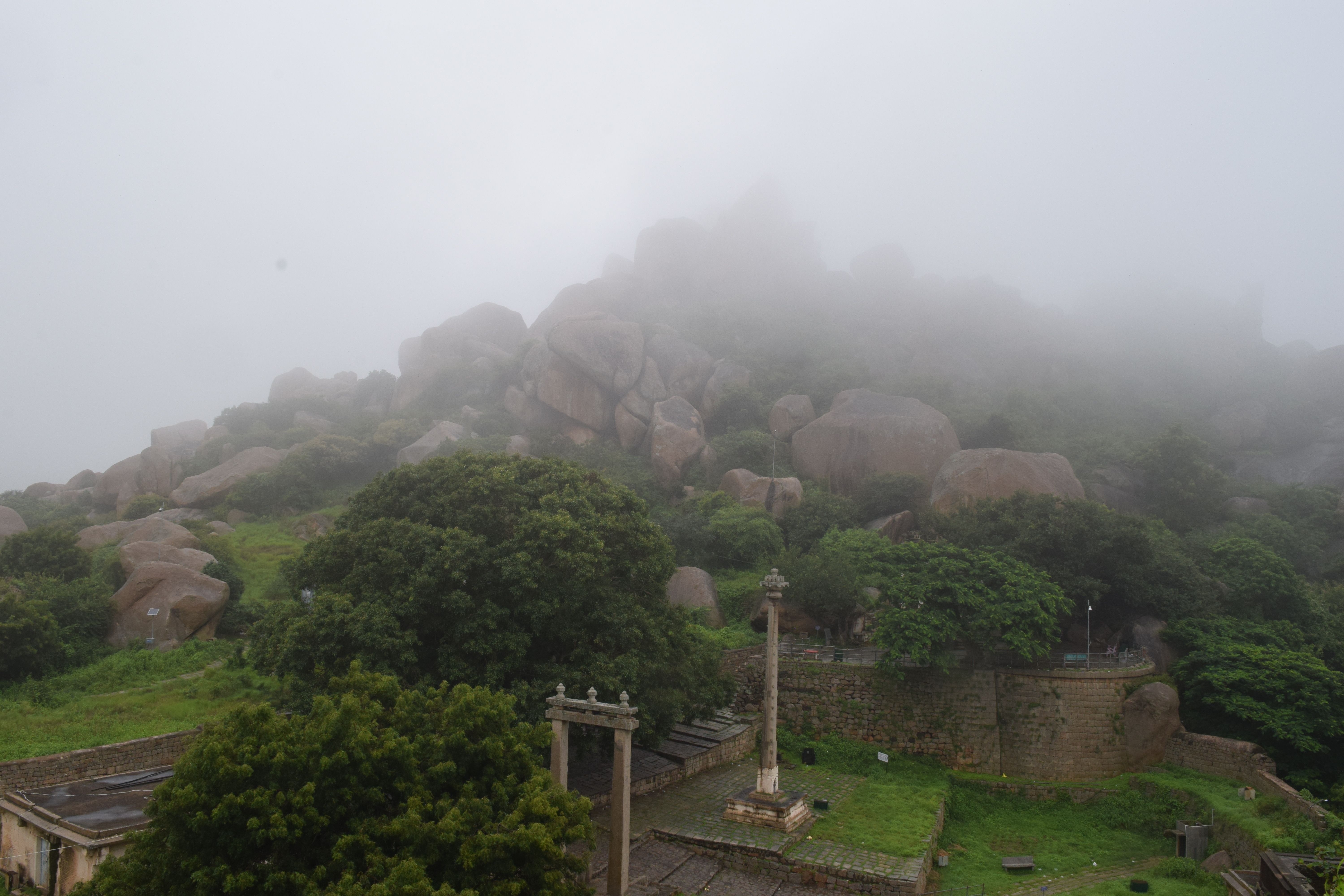
There were fetching low clouds hanging over the formations of rocks on the 'betta's or small hills that dot the landscape, many of which are enclosed by the seven lines of fort walls (succeeding dynasties seem to have found earlier walls pregnable, so they just said, 'What the hell, let's do another one'.  The result of such obsessive insecurity is 32 kilometres of walls (and some very sore hands)).

Here's one such wall.

To its credit, this part of the wall is aesthetic and done with a certain taste.  These views are personal: a potential invader is unlikely to focus on the aesthetics with an approving eye, the design being such that he'd have to be super human to scramble up. 


Just another picture to let you know what you missed.  This is the remains of the palace with granaries and baths and all the rest of it.  


The fort has a number of temples (in the distance), some under giant boulders, and an incredible tapestry of ruins, rocks and random rubble (which is the principal masonry style).  
And, for a change, the grass isn't greener on the other side (the other side of the fort is the town, so that sucks).


That structure up close - two pillars, with a beam on top, was apparently to host a couple of hooks from which a swing would dangle: for the queen, the princess or someone who was, at any rate, pretty loaded.    in comparison, the swings you see in a park look like Chihuahuas with protein deficiency.

A temple complex ahead in front, with the rocks in the distance.  If the only way of seeing this view everyday was to visit the temple, the most agnostic of rulers would turn deeply religious.   So, you kind of get the feeling that the folks who chose locations for temples had an early career in psychology.  

I take just a step to my right and am now in this verandah with pillars.  And this is the thing about photography: everyone just has to take a photo or two of a bunch of pillars in a straight line, its Pavlovian (about which you can learn more at https://en.wikipedia.org/wiki/Classical_conditioning.  We believe in holistic education).  

The building held up by these pillars isn't arresting enough, so we look inside and see at a vast empty space with a strong suggestion of mice and bats that are competing to produce smells with higher pungency,  and move on.  


The structure to the left is a 'gaali dwar', for the royals to get the breeze and the one to the right is the entrance to the temple in front of which I stood while taking this photograph.  Isn't the scene surreal...utterly beautiful?  We just stood soaking it all in (well, literally as well...).
And the question that haunts me is: just how did those folks lift all the stones up a couple of storeys? Where did they get that superhuman strength from?


No, Horlicks has been around for a while, but not that long.  Even I know that.


Now, this is just the sort of photo I'd take to show off.  

Anand was blocking the doorway, so I asked him to crouch behind the pillar in the larger interest of Art and he nearly threw his slipper at my Nikon.  
After all that I have done for him over the years......

The pillars all over had some lovely carvings 

...but this one sort of freaked me out a bit.  Which probably was the intent anyways (not to freak me out, if you see what I mean, but humans in general).  
I wouldn't want to meet this guy in broad daylight on MG Road, let alone anywhere else.  Which brings me to contemporary dangers in the fort: leopards and bears are known to wander around, so stick to your paths and mind your language.

The panther is like a leopard
Except it hasn't been peppered
Should you behold a panther crouch
Prepared to say Ouch
Better yet, if called by a panther
Don't anther
(not me, Ogden Nash)

The stuff that I did not photograph were the outstanding rainwater harvesting ponds, carved and teased out of rock (a sure sign of genius this, missing the ponds for the rocks.  Runs in the family). 

Back to serious reporting.  This is where one of those Hyder-Tipu Universe Boss chaps set up a grinder for gunpowder, using circular grinding stones turned by horses and bulls, managed by, of course, humans.  I cannot think of a riskier thing to do in life, but, of course,  it's a free country (well, not in those times, I agree).  Plus, both those chaps were a bit cuckoo (else why would you conquer Mysore, for Heaven's sake?  The most innocuous folks around live there).

On second thoughts, I would rather grind gunpowder than cross Outer Ring Road.  

And, that brings us, finally to the tale of Onake Obavva (now, that's a name to have).  She was a warrior woman who fought the soldiers of Hyder Ali in 1779 and knocked off several of them with her Onake (a heavy wooden pestle that gets the shivers doing a decathlon on your backbone).  O2 hid near a narrow passage that they had to cross and then bumped them off (literally, of course) one by one.  Smart woman this, but looking at the passage - which is now called Onake Obavvana kindi - you do feel sorry for those soldiers, even if they were daft enough to be with the Hyder-Tipu mafiosi.  Getting your skull fragmented isn't (at the best of times, even with air-conditioning and Dettol invented) a pleasant experience.  At some point, she met her end as well, so that was heroic.  

We stood for a moment in silence as a mark of respect to O2 for what she had done and then hurried off towards the exit.  It was mid-morning - 11 am - when we left the fort, soaked to the 206th bone (it had been raining without a break all the while) and feeling just what a wanderer would feel without an agenda or mobile connectivity.  In a word, bliss.

About a kilometre down the road, at Lakshmi Bhavan - hugely recommended to us as a venerable eatery - idlis and dosas were calling out to be eaten, so one needed to be responsible and fulfill that duty.  
Someday, we might return to add an eighth wall.  Stay posted.


Wednesday, July 27, 2022

A Tale of Two Flowers: A Forest of Ribbons


It's an unusually warm July afternoon to be walking by the forest boundary, Having taken in my fill of the Glory Lily and listening to Ananda's impromptu lecture in ethnobotany, I stroll contentedly.  In my hand are two fruits of Careya Arborea, a handsome tree with flowers of ineffable beauty - for this is the fruiting season - in the faint hope that I will be able to sprout some seeds at Random Rubble.

We see Venkatamadappa grazing his two cows and stop to chat.  He is an intrepid man-of-the-forest, for his land abuts the boundary and today he is in a foul mood, complaining about the elephants and the damage they have caused him.  
"This fence is useless," he says, pointing to the robust pillar-cable-and-electric line that extends for kilometres, done by the Forest Department.  "Not true," Ananda counters, "this fence has kept the herds away.  It's only the three bulls who cross it now. That is a big relief."

Madappa, of course, is least convinced and continues to argue; when your cows are grazing, no better past time can present itself.  He wishes he says that these elephants would go away, once and for all.   

Then, Ananda points to a pile of elephant dung, now drying in the sun, and he has a smile on his face.  "Sir," he speaks to me, but I suspect he is talking to Madappa, "look at the saplings growing in the dung."


With a stick, he sifts through fibre and mango seeds in the large pile and then points to the tiny saplings and to the fruits of Careya in my hand. "Three Careya saplings in one pile of dung! Elephants will sprout these better than you do.  They are the real tree planters!" he says with flourish. 

Madappa looks skeptical, but Ananda is now listing the species of trees, shrubs and grasses that the elephants disperse in their dung and it is an impressive panoply.  Yet,as I listen, my mind trails away.  What if I tied a ribbon to each of these saplings to keep notes? I think.  What if I tied a ribbon to every tree an elephant planted?  

Under the afternoon sun, I am in a world of my own for a minute: in my mind's eye, I can see a scrub-and-deciduous forest, with a ribbon tied to each tree.........   


A tale of Two Flowers: The Glory Lily and a One-Eyed Elephant


Nellamar Agraharam
circa: July 23rd, 2022

The monsoon begets its colour - greys, and green dominate the sky and the farm earth - but, in the forest, the Gloriosa Superba - or Glory Lilly, in English - is in bloom. 

There is no sight more beautiful or a flower more delicate than this, a work of subtle art, tapestry and weave.  In a dense foliage of green, rendered lush by rain, the red-and-yellow stands in fetching contrast.
 

In a month or two, the flowers will wither away and the creeper will assume its unostentatious air, but for now, it is a show to watch.  The scarcity of its beauty makes it special.  Special enough to be on a postage stamp in an era when two rupees fetched you a day's meal. 

Pause for a moment to consider why the normal rules that mark out a flower are overturned here, with the stamens outside (unlike, say, Intel) and at a rakish angle to catch the ventral side of butterflies who are the pollinators-in-chief.  


In pollination terms, - and Bob Dylan will have strong views on this -  the answer, my friend, isn't blowing in the wind. 


Mottai Waal - the one-eyed gentle elephant, was here too, but he doesn't quite have an eye - his remaining one - for flowers.  

...and he left behind (pun intended), in this pile, a few seeds of Careya Arborea after chomping on its fruit (samples added to picture)., that are now sprouting away  Careya is another magically beautiful flower, and rare.  We need more like him


Friday, July 22, 2022

Bulls, Bikes and Baigan Barfi

Today is the World Day for Bulls.  
Just bulls. Not the stuff they produce from, you know, the er...other end of the other side. 
On this lovely day, filled with the most delightful puns (such as "today's news bull-etin featured Fidel Castration" and "Now Cowfirmed: Bulls love chocolate moos"), here is a piece that I had written some years ago about one bull that made its mark (actually, it nearly did). 
Read on..

Recently, I was at a farm with a group of friends, one of whom  came on his BMW bike.  Now, if you haven’t seen these, they were originally armoured tanks, which have been sliced longitudinally, with great big boxes on either side of the rear wheel to accommodate a giraffe and his mother-in-law’s opinions.  

As we were at the gate, preparing to return – we in a car, with Mr. Big Muscle Wonder on BMW in front- a young bull that had been grazing nearby turned up and stood right in front.  He (the bull) had an odd gleam in his eye and stared unblinkingly at the BMW with some disdain, looking askance.  

Now, there are only two reasons for a bull to stare at a BMW unblinkingly and look askance.
a) He has a problem with Germany’s trade surplus; or
b) He doesn’t like the bike.
The prudent course of action (recommended in the book Bees, Birds and Bulls-that-stare) is to not discuss the trade deficit with him but to retreat slowly keeping your eye on the opponent and with your stance ready (head behind the gloves, chin slightly down, eyes over the gloves).
   Well, Big Muscle did none of these.  He tried to shoo Bull away by saying (what else) ‘Shoo’.  When Bull showed no remorse, he tried again, in a louder tone and sounded the horn (the only instrument that is present in both the players concerned).  Bull showed surprise and took four steps back, but what Big Muscle saw as retreat was merely Bull marking his run-up.
The BMW took off down the dirt track followed closely by the following forms of transport:
• The Bull

It was evident that Bull’s AI has been programmed with the code ‘Stay six inches from BMW bikes’ and he raced behind a terrified Big Muscle, who now tested the bike more than its engineers had ever imagined (unless a BMW engineer once asked, ‘Gosh, is this bike safe from bulls?’).  

We took off too, our driver planning to intercept the possible liaison of Bull and BMW and for the next two minutes we followed the race closely, the BMW winning, but the Bull just behind (Hertz: We Try Harder).  Even as Big Muscle increased the speed to Mach 1, his rear view mirror (Caution: Objects in the mirror are closer than they appear) showed the following scenery:
• The Bull

When they reached the first bend – the real F1 test – the Big Muscle (+ giraffe + mother-in-law’s opinions) took a sharp turn to the left, while Big B took the Euclidean route – Geometry is always where bulls score an A – and shot off straight, changing his direction only a second later on realising that there were shrubs in front, grasses in front, even maybe the odd cow in front, but no BMW. 

At the next curve, he met Big Muscle (but not cordially) and nearly made a dent in the Giraffe Box, to repair which Big Muscle would have to take a housing loan (a bull costs only 30k, even an overfed, angry one.  Big Muscle would have gladly bought a hundred cows to placate this fellow, and still saved money to buy a 1 BHK).  But he, the Bull, missed this opportunity to make his mark (no, not the Deutsche Mark, we are not obsessed with world trade) and then lost steam, merely trotting beside our car in deep regret.  

A kilometre later, a sweating Big Muscle was waiting for us, examining his bellowed bike (an utterly despicable pun, this).  “Shit,” was all he could say.  
On reflection, he did seem lighter.

Sunday, July 10, 2022

...and in the forest is a tea stall.....

 If you drive through the little town of Kutta in  South Coorg and cross the border into Kerala, the lovely wildlife sanctuary of Wayanad awaits you, with its easy winding roads and sweet smells of summer or the light drums of the early monsoon rain on your windshield.  The air is light and carries anticipation…a forest always does…..  This is a land of tribes and rich ecological ancestry, about all of which I am only just beginning to learn.  But, today, that can wait.

A few kilometres down the road and you turn up at a point where a right would lead you to the fetching village of Tirunelli in the southern fold of the Brahmagiris, its ancient temple standing on top of a small hill.  But, for a while, that can wait too.

At that fork in the road, park your car and head across to the tiny tea stall – the only shop  of any kind there, in the middle of deciduous forest – and find a seat which, if you have timed it all poorly and are there on a weekend, is about as easy as melting rock.  There is a large vessel on the firewood stove and the smoky fragrance mingles with a rich flavour of tea, as regular glasses of it - black tea or kattan chaya – fly off the aluminium tray.  But, for a moment, just a moment, that can wait too. 

You are here  for something else: this little tea shop is in a league of its own, for it is the home of the finest Unni appam on the planet (about this assertion, be warned that no prisoners will be taken, in the event of disagreement). 

The Unni appam is somewhat like a large odd-looking dark chocolate mushroom without the stem (which is, admittedly, a useless description and about as helpful as online remedies for toothache). Soft and crunchy on the outside, the inside has banana, jaggery, ghee and a few sprinklings of coconut-oil flavoured Heaven.  For any further details, check with Google chacha, of course, but to know why this little tea shop is the finest in the Honours List, order a couple of them, with kattan chaya, which is an excellent accompaniment (these two are ‘sympatric’ is what these insane wildlifers will tell you).  Each Unni appam costs – hold your wallet and breath – a ridiculously modest six rupees.

You are served in an instant, and will now spend the next quarter of an hour in a delightful silence (money-back guarantee.  Even the discerning Mallus are silenced, which is saying much), punctuated with rhythmic munching and the occasional “hmmm…hmmmm” of contentment.  And, when you are done with this, take your wallet out carefully and put it into another pocket, because you will order two more now.  Trust me, these things matter.

Some years ago, while in a Kerala bus, I told the conductor “Unni appam stop” with trepidation, for these are formidable adversaries of humanity.  He stared at me and said, “Forty rupees” and his smile line moved by a fraction of a millimetre. The bus, driven by an uncertified maniac, screeched to a halt in front of the stall and, by the time I got down with my bag, the conductor had hopped down, bought four Unni appams and re-boarded at the front to share them with the maniac.  

You never cross a temple without stopping, it is said.