Friday, February 25, 2022

A Spring In The Step

 It is quiet and warm in the afternoon, as we tread on fallen leaves inside the forest, a dry deciduous belt of green, now turning colour with the change in season.  The morning mist is lighter and has given way to warmer mornings and the forest has taken note.  We – my old friend Ananda and I – see the solitary, yet astonishing orange of the flame of the forest, the odd wine-reds of the flowers of the silk cotton tree and russets of the terminalias.
 
Our walk though has a purpose, so we stop but briefly.  Ananda has spent all his life in this forest, so he knows the trees, small rock formations (‘this is kebballamma bande’, he informs me, as we stand on an outcrop of stone that is four billion years old, and counting), and bushes and grasses that I would easily miss.  Walking with him isn’t a trek, it is an education and he is a skilled, if sometimes dismissive, teacher. 
We have a purpose today. 
 
Every year, a few days before Shivratri, a magical event unfolds in our forest. Trees of a single species– Shorea roxburghii - are always always grouped together in stands and for much of the year they are non-descript (I wonder what they think of me.  On second thoughts, I’d rather not know).  Around this time of year, the stands of Jalaari mara – as the Shorea rox. is called in our parts - shakes off its collective somnolence and blooms, a word that cannot possibly do justice to an utterly fantastical panoply: each tree, hosting many thousand flowers of a delicate cream with the stand of a few dozen trees glistening from afar in the warmth of the midday sun. 
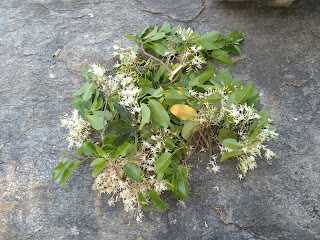
 
When we get there, the fragrance is over-powering, a million outpourings of scent that is delicate, bewitching and, once inhaled, never forgotten.  I am hesitant to pluck a bunch but Ananda has done it in a jiffy, so I sit with them around me, breathing in the fragrance and listening to the drone of a thousand bees. Pick a flower: it is science-meets-beauty-meets elegance, for the petals-and-stamen are intricately designed for the bees to reach the nectar and for you to paint with abandon on mind’s canvas, for your fingers to touch and caress.  This isn’t just botany and evolution, it is extraordinary magic at work, evolutionary caprice - a contradiction, if there ever was one – and a microcosm of enchantment. 


If you have read The Hidden Life of Trees, a brilliant, enlightening book of science, you will know that the Shorea cannot survive as a single tree, separated from its kind.  You will know from the book that these trees communicate with each other and with other species as well, exchange resources and work with collective altruism.   And knowing that they are sentient, alive in every conscious way like we are and, in so many ways, superior (ok, do you produce oxygen?), only increases the wonder.
 
A herd of elephants passed this way at night and they may have ruminated here too; in a deeper way, we are brethren, stopping by the Jalaari stand for those moments when even that great traveller – Time - sits still.
 
A fortnight later, as we will stroll under the stand, stepping on a million now-dried flowers that will nourish the soil, that afternoon will be a memory. 
Memories sit still too. 

Tuesday, February 22, 2022

Birds of a feather fumble together

This ditty is in honour of a relatively new species in avian evolutionary ecology: the active online male birder (homo sapien aviano-insanus) 

Nothing quite lifts a birder's online stature 
Than his adding to ornitho nomenclature
He loves to take a species and make it two subs, a pair
Though you might think this was splitting a hair
He will post his image of light from the setting Sun
On the pupil of the eye of the Red Necked Falcon.

The unintended result of his chasing the avian gene
Is to make a wanna-birder (me!), a birding has-been.
For, I, an amateur birder, have as the tools of study
Salim Ali, some beer and a binocs (10x) as buddy
The expert online birder has his well-thumbed book -
And a unique field guide with a  'got-the-bugger' look.

His camera has the barrel of an AK-47
And his telescope could focus on the Trinity in Heaven. 
His language is, well, unusual, and has me stymied
With words like cisticola, booted, harpy and pied.

I take solace then from a pointed little known fact
That men-birders aren't quite known for their tact
For they return from their sighting of the fishing eagle (less)
And quite miss out on their spouse's new dress.

Thursday, February 17, 2022

A Day For The OddBall

 Years ago, while I was volunteering for a wildlife rescue centre, we received a call.  Right on a busy road in the north of Bangalore, a friend of ours – an amateur wildlife enthusiast - was speaking to a man who stood with an odd looking animal that he was looking to sell.  It had been captured from an agriculture field, tied up and then sold to this man.

“Should I buy this?” the friend wondered, as he described this animal that he could not recognise (these were pre-Whatsapp days, so people described things).  Was buying wildlife to save it ethical, he added?  It is a question that I still do not have an answer to, other than to be a quintessential economist and say, “It depends….” 

As he described the animal, my pulse rate quickened.  I had never seen a pangolin before, but a photograph in Sanctuary was enough to make me fall in love with this Master Oddity, an evolutionary quirk with an amalgam of features borrowed from a plethora of species that is as endearing as it is, well, different.  Once upon a time, Brittania had a delicious little round biscuit called Britta, which was – this is a secret, so keep it to the 1.7 billion folks on Facebook and don’t spread it around – made from the leftover dough from all other biscuits that they made.

Pangolin is Nature’s Britta, with large scales of keratin, no teeth, an odd looking snout that suggests a penchant for tunnelling, a long sticky tongue and a decided appetite for ants and termites: one pangolin can knock off 70 million in a year (Yes, somebody spent his life counting this. Does he need career guidance?). 

I took a quick decision.  “Say that you have just spoken to your cousin who is a cop and is on his way here.” I have an old Gypsy, so it is a ruse that works sometimes… “make him give it to you for free or, at least, haggle till we reach.”  

When we reached, the man had vanished, but our friend was holding gingerly on to the pangolin. It was a large one, the snout was soft, delicate and beautiful and the eyes melted the heart (we are suckers for these things). And the good news was that it seemed to be unharmed. 

At the rescue centre, where it was put into an enclosure for a hour’s observation, it got to work right away, dug a hole and entrenched itself with such firmness that it took two folks to pull it out to be released in the wild.   


So, why is Feb 19th World Pangolin Day?

It is world’s most trafficked animal, captured and killed in ghastly ways to feed the fake medicines racket, ridiculous beliefs that its body parts – the scales in particular - could cure illnesses.  One statistic: in the four years between 2016 and 2019, the scales that were confiscated = 360,000 pangolins.  

Ogden Nash – who better? – ends The Pangolin Appendix, with this…
They're sought after because they are edible
But save them 'cuz they're pangolincredible!  


Saturday, January 22, 2022

Spray and pray

 Seenappa’s wife came with him to meet me the other day.  She is a tall, thin, hard-working woman, albeit a forbidding personality with a quick temper.

“Can you give me something really strong for a headache?” she asks, walking slowly to a seat and squinting through the obvious pain she is in. I know that she suffers from headaches often; when she does, her husband keeps his distance and bears the look of a starving terrified gladiator (how do I know what a starving terrified gladiator looks like?  Asterix).    

“I have some Crocin and Dolo. Will that help?”  When you aren’t a doc, it feels good to be treated as one.

Despite the discomfort, she smiles and shakes her head (when her husband shakes his head, it is because he thinks I am nuts).  “Sir, both will not help, neither will Saridon.  I have even taken 2 Dolo tablets at a time; it had no effect.” This is, of course, downright dangerous and can damage her liver, but I skip the point for the moment. 

I ask her a few obvious questions and call a doc back in Bangalore, but it’s useless; as with most migraines, there is no single cause.  I then remember seeing her in the morning, returning from their beans field, the pesticide sprayer slung over her shoulder.

“If you are prone to regular headaches, spraying poisonous chemicals is a trigger,” I tell her.  “You really should stop using pesticide.”  She says nothing, but lifts her head and gives me a withering look that speaks with eloquence, “Don’t foist your ridiculous ideas on me!” it says and I understand her viewpoint, though with reluctance. 

They leave shortly after and a few days later I see her returning from the beans field, with that sprayer on her back, so my homily has had little effect. 

Perhaps they connected the dots – monocrotophos to migraine - much before I did and have made peace with the devil.  They, and a million others, are conjoined in this matrix-cum-maelstrom of chemical farming to achieve a modest family dream – a small home in her case. It is hardly a dream to grudge….

In search of that ever-elusive bumper harvest – where high output and happy price will combine - migraine must yield to mania. 

As always, the question is: how do you change the script?    

Tuesday, January 4, 2022

The Wolf of Wall Street

In the year 1989, IIMB forgot its arithmetic: they hired more students than there were rooms and put up the excess baggage at D Quarters – affectionately called DQ - opposite the faculty housing. 

I belonged to this group of motley regulars and we kept our genius - that Superior Indefinable Intelligence - carefully away from academics of any sort (the one hard working chap - the indubitable Krishnan Nair - was much maligned by the rest for dragging our collective reputation down, until we realised that we could use his notes).  From the faculty, we had one humble, deeply-emotional request: unlimited compassion, when they evaluated our performance.  No sadism (such as comparison with those who had nothing better to do but study) or making-an-example-of kind of behaviour.     

So, when we heard that one of us - person or persons unknown - had apparently whistled at a Professor’s wife one late evening, there was considerable panic.   

This was not just any Professor (or any Professor’s wife).  For starters, he taught financial accounting – an arcane, terrifying subject to most. He was a fair, dour fellow, with the face of a WWF wrestler who was yet to win a bout but would nevertheless like to beat up somebody in compensation and it was rumoured that the only time he had been spotted smiling was while tearing up answer sheets of Life's Accounting Victims.   

So, here he was, complaining that one of us – one of this endearing, gentle, eviscerated, disenfranchised, embattled, docile, somnolent, enervated bunch – had done the unthinkable.

When we first heard the news, the immediate question that arose was a frightening one: Would we now have to listen to Chari’s jokes on the subject? 

The question of lesser impact, but of greater interest was: Did somebody – one of us – actually whistle at the lady? Not just whistle-whistle, but whistle in that meaningful, vile way that you see in Road Runner cartoons and in the 1980s films with white-shoes Jeetendra.  Was there a wolf among us (and if so, which species) ? 

"No", we all said.  In addition, we unanimously agreed that, when we did whistle meaningfully, it was at the sight of Dollops ice cream (dark chocolate, with nuts, caramel and dates).  This opinion poll carried no weight with the Prof (he had enough of his own, which is what happens when you eat curd-rice nine times a fricking day).   

The third question concerned the impact of this incident on all those who were in His class.  Some of us were in Section A, which he did not teach (who says there isn't a God up there?).   Emotions ranged from defiance, exhibited in much measure by the other Nair in DQ, to despair.  That last emotion, emanated, in particular, from Vish Mathur, whose fear of accounting led to the addition of the word Debitophobia to the lexicon (this has later changed to Ebitaphobia, when making profits means that you are sick and need therapy.  Serious reporting follows, sorry again).  SatRao, another DQ stalwart, used to wake up in the night and say, "Fight, fight" to inspire his troops (noticeably himself). 

The final question concerned the next course of action and the President of our batch, Bhushan, joined the group in an all-hands, no music, this-is-serious-stuff sort of meet.

The news from the political leadership was not good.  The Professor, the suspicious accountant that he was, had the solution all worked out: we would have to exit DQ.  Being an adroit diplomat with commendable ownership, Bhushan moved to damage-control mode.  A key factor in our favour, in addition to the lack of any evidence (particularly the inability of the Plaintiff to duplicate the pitch and tone of the whistle), was that there was a fair bit of construction activity around the campus – could someone else have done this? When you have eliminated the impossible (i.e., us), whatever remains, however improbable, must be the truth (not mine. AC Doyle).   

The resultant meeting between the President and the concerned faculty member who oversaw this incident’s resolution was conclusive: Bhushan firmly defended us, his belief in the quality of IIMB students (and their inability to wolf-whistle) unwavering and resolute and the Professor of Financial Accounting had to make peace with one Provision for a Bad and Doubtful Debt.   

As a group, of course, we prohibited any form of whistling while in the shower.  Santy was persuaded to tune up his guitar to stifle any resemblance to a whistle, while those with perpetually blocked noses had to steam-inhale before they slept.

And, needless to add, the mystery remains to this day: just who did whistle at this demure, dignified lady?   


Friday, December 10, 2021

What's in a name?

Some decades ago, when I was in my early teens, we had an occasional visitor – an acquaintance of Dad’s – who was an interesting character. A portly fellow with a heavy paunch that rolled over his belt - the result of deep, unbiased affection for starch and red meat and pudding - he was from the rubber country of Kottayam.  Being a brainy dude, he did his Chartered Accountancy and worked for a leading CA firm in Bangalore, but, far from numbers, was principally interested in 3 things (in increasing order of importance):
1. Any beverage that had been fermented, particularly if it rhymed with frisky
2. Horse racing
3. Himself.
 
To this last topic, he devoted much of his research, fascination and his conversation, usually after downing a Patiala peg. The chap would speak about himself in hushed, reverential tones, and the anecdotes attesting to this Superior Intelligence were as awe-inspiring as they were fictional.  Dad would sit there patiently listening to excruciating details of how this Whizkid had won money at the races or shown his boss that he (the boss) was an ignoramus, while the rest of us would smirk and giggle.
 
But here’s the catch: none of us were quite sure of the fellow’s name. Dad vaguely remembered that he was a Mathew, but was there a George too in it?  I disagreed immediately because the initials on his briefcase did not match (I was obsessed with Sherlock Holmes at that time, as you can infer).  My mother recalled meeting his long-suffering wife, who had referred to him by another name – she would have been justified in calling him names of a different genre too, as you will agree, but let us not divert from serious reportage.   To resolve this vexing issue, we had a short family conclave, where we recalled earlier conversations and short-listed the possibilities to George, Mathew, Abraham and Thomas. Unable to proceed further, the fellow was now named GMAT.
The name, I am glad to report, stuck and any call from GMAT on the landline had me covering the mouthpiece and yelling, “Dad, it’s GMAT for you”, which is likely to have transmitted clearly to the other end even in those primitive Bangalore Telephone days. 
 
(If you are shocked enough to delete my name from your friends directory, note that this is hardly the only blooper I made, having once asked my mom, “Is Dad at home?  Pesticide Radhakrishnan wants to speak with him.” I was immediately given a lecture by mum, after which I asked her if, in future, I should refer to this senior manager of Pest Control India as Pesticide Uncle instead.  Apparently, mum then decided that  she would let sleeping dogs - and sons with inadequate appreciation of niceties - lie.)
 
My Dad, had the last word on GMAT, comparing the human to the exam: spending an hour with the test paper was a test of skill, he said, while an hour with the other was one of will. 

Monday, December 6, 2021

Why I Am Likely to Win The Nobel Prize

I am deeply touched that millions of people are buying cryptocurrency.  For years, I had been searching for a reliable way to measure the percentage of idiots in a population.  My ultimate goal, as you have now shrewdly guessed, is the Nobel Prize for Economics and Literature combined, and I was, until recently, about as far from it as Orion is from Earth.
ps: Orion is getting closer at the rate of six inches a year.  Persistence pays (but not in cryptocurrency).
 
The current population of gullible, naïve, inept, self-delused, infatuated, doting, obsessed, asinine, gauch, gumptionless, bird-witted, desipient, unstable idiots on our planet is officially at about 240 million, which translates to about 72% of the population of the United States (do not read anything more into this).  These are people (crypto buyers, not Americans) who wake up all animated in the morning and say, “Is there a new scheme to defraud me?” and, if they hear an echo, they do a funds transfer.
 
The most heartening news, of course, is that the population of idiots is exploding and new precious insights are a daily occurrence. For instance, one recent discovery is that crypto buyers do not know the difference between a virus and a cryptocurrency: apparently, Omicron, a cryptocurrency that was launched at the beginning of November moved from $65 to $325 after the virus variant was named.  They assumed (with crystal clear, profound, incontrovertible logic) that since both are invisible to the naked eye, they are the same.
 
Another one called Dogecoin that was set up as a joke even has its founder screaming, “Don’t buy, it’s a scam” Dogecoin buyer-idiots, who will not recognise a mistake if you present it to them in a lava-encrusted pressure cooker-with-weight, are convinced that this is reverse psychology at work, so they buy even more.  There is even a coin called SafeMoon that has been thoughtfully named by its creators who live there and prefer that the idiots stay on Earth. 
 

Then, there is the ultimate scam called Bitcoin that is today priced at Rs 37 lakhs a piece, which is the same price as a BMW X1 (which is where the similarity ends).  If someone had bought it years ago, being an Early Idiot and held on for years and years, he would now be worth Rs 37 lakhs in fake money.  Which, I must agree, is a lot of fake money to have, because I play Monopoly regularly and have never seen so much.
 
More later.  My Nobel is waiting.