Monday, April 4, 2022

WhatsApp in Moradabad

Not sure if you have been reading the right stuff in the newspapers these days, but the only news I paid attention to was one that rated the noisiest cities in the world and had Moradabad as the second loudest.  This kind of measurement is, of course, absolute tripe and rubbish, complete nonsense, and is done by people who were born just after the Industrial Revolution had reached Haiti (where they probably still live in a building called Out-Of-Touch).  Nonsense, because this measurement does not consider Whatsapp Groups to be a city. 
 
Now to brass tacks (which, if you know Moradabad, is a most disreputable pun.  Shocking, the levels I stoop to on Sundays).
 
I have – under duress, pinky promise – been made a member of our neighbourhood Whatsapp Group under the utterly delusional impression that the objective of this Group was to discuss the neighbourhood.
Generally, daily conversations on this group begin this way:
“Good morning”
“Good morning”
“Yes, good morning”
“Thank you.  Good morning”
….which continues till it is afternoon.  Since nobody finds anything good about afternoon, there are no postings.
But the real action – the stuff of Kamikaze legend – begins around 5 pm.
 
“OMG! THERE IS A MOSQUITO IN MY KITCHEN”
“OMG”
“OMG”

…which continues till someone – generally a chap called Kosandri Ranganatha Somanna Srinivas – asks how OMG should be pronounced.
Everyone, of course, ignores him.  Another deeply sympathetic soul with blood and the future of civilisation at perilious stake will then say,
“THIS IS TERRIBLE.  A MOSQUITO, IMAGINE! THIS IS DENGUE SEASON.”
 
I must take a commercial break here to point out that everyone uses capitals, even Kosandri Ranganatha Somanna Srinivas does while writing his name, because it is like a cricket stadium – when everyone stands up to see a dog running onto the pitch, no one who sits down has a hope in hell (of seeing the dog do to a stump what it generally does, that is).  
ps: the aspirations people have are distressing.  But back to breaking news.
 
The conversation immediately shifts to dengue’s body count last season and what needs to be done.
….which is the perfect moment for IMHO.  This stands for “In My Honest Opinion”.  What it actually stands for is “I Am Completely Jobless At This Moment, Have Never Thought About This Issue But This Is A Democracy”.  
So, everyone criticises the Municipal Corporation and provides entirely unworkable solutions ("MONTREAL USED 83 DRONES TO SHOOT DOWN 7 MOSQUIS LAST WEEK") that will not be implemented till 2145 AD, each such solution prefaced with IMHO and followed by YAR (You Are Right).  About 62.4 percent of this group is so lazy that they just do a ‘+1’ – this stands for ‘We All Knew You Were A Total Idiot And Now You Have Company In Me’.
 
When these solutions are being discussed animatedly and excitement is at its peak, a chap called Ramakrishna Shastry – who I hope fries one day in boiling castor oil and is then garnished with Kandhari chilli – forwards a post which says
 
PAKISTAN HAS DESIGNS ON INDIA”, which normally runs into about a thousand words.
 
There is an immediate howl of protest by society, with people castigating him.  “Not Relevant”, “Can we stay focused on this pointless discussion, instead?” “IMHO’s and ‘+1’ s, after which he goes off deeply satisfied, no doubt, to have his evening toddy-on-the-rocks.
 
There is never any conclusion, of course, so everyone wishes each other GOOD NIGHT and TG (“That’s Great”, without specifying what is).  I believe Moradabad is fighting hard to become the noisiest city in the World but it has about as much chance as Kosandri Ranganatha Somanna Srinivas has of knowing how to pronounce OMG.

final ps: 
I now hope you are, like me, a member of the secret cult called “Anything But Whatsapp Groups” where people wear black hoods and roam the streets searching for victims-posting-OMGs-and-IMHO-stuff. 


Thursday, March 31, 2022

Photoblog: The David Scott Trail

Our view is of a sacred forest grove outside Mawphlang village.  We are eight of us and a better hike group has never been assembled in human history (well, after Alexander anyway).  There's Bob, our trek guide, about whom I should write a blog - sorry, a book - sometime.   None of us can ever aspire to be Yul Brynner.  Bob does not just aspire, he is Yul Brynner from The King And I, with his grin and corny Whatsapp humour and a head that last saw hair around the French Revolution. When he does not guide groups like ours, he loses money in cryptocurrency, but has theories to justify that (and everything).  Serious. 

Then there's the rest of us - mavericks, conformists, seekers, philosophers-after-gin-and-tonic, followers, vegans. A vegan can be a philosopher and seeker, I am informed, but Set Theory - the stuff where you do circles and intersections - was never a forte.  I learn on this hike that there is a Set Theory of sorts at play with the Khasis and their sacred groves in Meghalaya too: a family could have Catholics and traditional believers, the new and the old, the real and, well, the ethereal.  

The traditionalists believed in their spiritualism - though now in terminal, regrettable decline - a relic of symbolism and spirits that has ensured the preservation of its sacred groves, dolmens and stones of memory.  This sacred forest in front of us - with a panoptic view of stunning rich green, radiating in the midday sun - is real and ethereal as well. Will it last, bearing the onslaught of religion?  It is a dismaying thought but we must not worry about what we cannot control.....

(As an aside, and for your intellectual refurbishment, here is what the world's finest town newspaper has to say https://theshillongtimes.com/2016/01/07/the-traditional-religion-of-the-khasis/)

Mawphlang village has its clothes put out to dry - washing laundry is an obsession in Khasi-land.  Some cultures have totem poles, Mawphlang has its laundry on a wire and its shoes - scrubbed white to blind - on a rod.  Perhaps, as the Mahatma on the NREGA tablet will attest, the essence is the same.

We are in high spirits, following in the footsteps of David Scott who took this path - on his high horse, no doubt - to Sylhet in Bangladesh and then got it named after him (no, not Sylhet, but the trail).  By all accounts, he was quite an odd fellow, which is true of all Scots who have ever existed- it's something to do with all that peated whisky that they have tucked in and the cold in Aberdeen (no one who is remotely normal could have invented golf).

As we descend into the valley - the gradual incline begins almost at once - the view of the forest is fetching and hypnotic: rich green interspersed with pink blossoms dot the hill on our right and the rolling hills go on and on.  We are told by Bob that all of this land is in private hands or owned by a community.  This beggars belief (well, for me anyway): these incredibly rich jewels of biodiversity owned by individuals who can do what they wish with it?  


You see what I mean?

There is pine as well - the old villain of montane forests, that has destroyed native forests and implanted its monoculture to devastating effect.  As we walk, we see denuded, deforested, sliced hillsides and I now have a part answer: where logging forests and getting the timber out is impossible, it's left alone.  For the rest, there is much to be worried about.  Cassandra - and timber contractors - would be in business here.  


We stop by a lovely little stream to fill our bottles, soak our heads in its trickle and delay the hike.  Streams like these are my raison d'etre and I dream of a life spent in a tent alongside their clear flow; but then, that moment is now. Those large shrubs could be small trees, or the other way around and those stones have much to tell us in their shapes.....they are meant to slow the water - and us - down.  

Nothing like philosophy in verse. Or the inverse of philosophy.

Hanumanth must be the closest an Indian has reached to looking like David Scott - note the hat.....
....or is it the other way around: that David Scott bore a resemblance to Hanumanth?  Priorities, Watson, priorities.


Then, there is Millie.  And, where there is Millie, there is food.  None of us complain, though the Tempo Traveller we go around in takes a dim view of it all.  And, after all the food has been loaded in the back seat, the person sitting there has a dim view too (and a happy bounce).

Millie, gentle mystic, vegan, follower, leader-cum-feeder, cheese-maker. 
She carried so much food in from Bangalore that
the excess baggage fare has lifted Indigo's quarterly profit estimates. 

We begin walking (a sentence that has inspired a dozen songs and a million Instagrammers who have no idea what it is - walking, that is, not Instagram).  And, while we are in that valley, the forests envelop us in a warm, comfortable embrace.  


Yet, we sense something is wrong here; it is a visceral feeling, a sense of absence, a void in the canopy, for we hear no bird calls.  None at all, in this dark, melancholic, rich, wet deciduous and evergreen forest.  I berate myself for noticing what isn't there, rather than what is, but that too is, in every way, visceral.  Hunting, Bob tells us, is a way of life.  Or rather, of taking life away.   I wish it could be all different, but then if wishes were horses......

We cross the bridge over the Umiam river, on its mildly swaying suspended span.  Like the other head water rivers of Meghalaya, this is clean, a pleasant green and, in mid-March, shallow.  Rivers do something to me; I want to dive in right away and swim lightly with the current, yet fear it for its depth and for what might lie beneath, unknown.  That too is visceral.  
We walk alongside the river, stopping to smell flowers, take in the air and see - as there inevitably will be - the bend in the river.  The waters cut through rock and create a channel between two hills.  This could be another - perhaps the main - reason I fear a river as much as I adore it, it has magnificent power that is well concealed beneath its placid waters, a grip that can thrall but throttle, charm yet choke.  
Rivers.  I could go on and on......


I love that phrase - the bend in the river.  Do you?

We walk down to another valley, cross a stream that joins the Umiam and then climb up again.  When you are on a hike, much of this seems pointless really, a down-up-down routine, yet there are conversations you have: with the others, the odd passer-by and with yourself.  You stop to take in the beauty and to etch that scene in an otherwise-fickle and often flexible memory.  


We walk past what seems like an invasive plant with pretty yellow flowers and landscapes of ferns, delicate and dainty and of use in local cuisine.  Nothing could be more charming to see, tall trees on the sides and ferns in the folds, with trickles of water flowing by them.  As with everything evolutionary, there is some magic at work here.  


We are in the village with no name (or so I think).  There is Maggi to be eaten (yuck) and tea and the noisy company of four software engineers who work in Bangalore, all with immense self-belief and nonchalance.   I would rather not take photos with them, despite the common connection.  Rather, there are these two who steal my heart with their nonchalance too, an air of living for today, hakuna matata.
 
Now, this gets my goat

This guy - the man on the side, not the goat above - has his priorities right.  Basking in the sun, with a lazy line in the stream and that conical basket behind him to hold his catch.  This basket must be a cultural totem (ignore those white shoes), for they are everywhere and used for everything:  it isn't odd to see the occasional Khasi lady climb a hill with a baby peeping out of this wonder of a cone,  the sturdy strap of which goes over her head.  It is an image I grew up with in Digboi, filled with nostalgia of another day  (as an aside, if you didn't already think of it, the goat has its priorities right too.  Until it meets the butcher, that is).  
The landscape changes from here on - there are people along the village stream and beyond, an unusual interlocked-stone bridge over it (absolutely riveting, with the pun thrown in) that, if it was designed by Mr. Scott, should make him the ultimate ol' world Scotsman (who were as talented as they were nuts).


........and immense deforestation that I have no wish to remember but needs to be recorded.  The perils of private ownership of forests (or a pitch against capitalism in conserving them) is hardly a subject for intellectual discussion on this walk. It is QED - quod erat demonstrandum -  proven, in a way, beyond argument.  


I look away to my left and an immense rock formation looms high above, an overhang with a large open cave.  What would it have been like in the old days to live beneath that, to peep out on a starry night and shiver in the Khasi monsoons, to encounter fauna that seeks your place to rest and worship all that you never understood?  To wonder about this - and a hundred other 'ifs' and wishes and winter's kisses - that is why we hike.  Up and down hills and valleys. 

In a bit we are done.  We wait by the road head as the Tempo Traveller rolls up with a groan, and clamber in for the last leg to Sohra or Cherrapunjee, as the Brits knew it.  A long day and I am beyond thinking now. 
As always, where thought ends, the trail does too.


Tuesday, March 22, 2022

Missing the forest for the .....

Question: would you agree to having a fine tooth removed and replaced by an implant because it helped GDP?
No?  Well, you are holding back India’s growth story.
Read on…
 
I am going through an old issue – December 2000 - of Sanctuary mag and there is a feeling of depressing familiarity. It quotes the then Director of Project Tiger as stating (at the Millennium Tiger Conference in 1999) that, in about 25 years since the launch of Project Tiger in 1973, India had lost half of its standing tiger forests – 150,000 square kilometres of forest land that would never again see another tiger pugmark.
Let’s put that in perspective:
That is 15 million hectares. 37 million acres
About 70 times the combined size of Bandipur + Nagarhole + Wayanad.
…and we now know that in 2000 the destruction had only begun.
 
A ghastly haircut this. Meghalaya 2022
In 2020-21 – just one year, mind you – we are told that about 31 lakh trees (largely in forests) were cut for public infrastructure projects: largely roads, which are now a national obsession. We are told that you need to break an egg to make an omelette, so this is inevitable. An equal number were planted somewhere, we are told, so there’s no problem. And then, voila! We are told that India’s forest cover has increased. 

Fiction flows.
 
Fact: few planted trees survive.  
Even if they did, a forest is not a collection of trees, it is a living, dynamic, complex, interactive ecosystem about which we know, well, nothing really.  
We do not know what we do not know.

 
Yesterday was World Water Day and you must have read the odd trite tweet as a tribute, perhaps a eulogy.  The day earlier was International Day for Forests and we must wonder if these are different.
Forest = water.
 
Stand up for our forests. 
They need you.
You need them.
 

Wednesday, March 9, 2022

An Ode to the Weevil

 The weevil, an insect that looks quite odd
With elongated snout & an abdomen broad
See one in your rice?
Say hello, be nice
Or a zillion pals will arrive on his nod.
 
Make small talk, ask of his kin, be civil
If Putin were in your rice, now THAT would be evil
Take his profile pic
Then crush him with a brick
If you simply can't or won't, then,….er, weevil. 

Friday, February 25, 2022

A Spring In The Step

 It is quiet and warm in the afternoon, as we tread on fallen leaves inside the forest, a dry deciduous belt of green, now turning colour with the change in season.  The morning mist is lighter and has given way to warmer mornings and the forest has taken note.  We – my old friend Ananda and I – see the solitary, yet astonishing orange of the flame of the forest, the odd wine-reds of the flowers of the silk cotton tree and russets of the terminalias.
 
Our walk though has a purpose, so we stop but briefly.  Ananda has spent all his life in this forest, so he knows the trees, small rock formations (‘this is kebballamma bande’, he informs me, as we stand on an outcrop of stone that is four billion years old, and counting), and bushes and grasses that I would easily miss.  Walking with him isn’t a trek, it is an education and he is a skilled, if sometimes dismissive, teacher. 
We have a purpose today. 
 
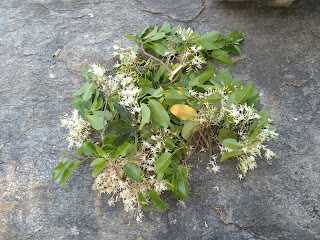
Every year, a few days before Shivratri, a magical event unfolds in our forest. Trees of a single species– Shorea roxburghii - are always always grouped together in stands and for much of the year they are non-descript (I wonder what they think of me.  On second thoughts, I’d rather not know).  Around this time of year, the stands of Jalaari mara – as the Shorea rox. is called in our parts - shakes off its collective somnolence and blooms, a word that cannot possibly do justice to an utterly fantastical panoply: each tree, hosting many thousand flowers of a delicate cream with the stand of a few dozen trees glistening from afar in the warmth of the midday sun. 
 
When we get there, the fragrance is over-powering, a million outpourings of scent that is delicate, bewitching and, once inhaled, never forgotten.  I am hesitant to pluck a bunch but Ananda has done it in a jiffy, so I sit with them around me, breathing in the fragrance and listening to the drone of a thousand bees. Pick a flower: it is science-meets-beauty-meets elegance, for the petals-and-stamen are intricately designed for the bees to reach the nectar and for you to paint with abandon on mind’s canvas, for your fingers to touch and caress.  This isn’t just botany and evolution, it is extraordinary magic at work, evolutionary caprice - a contradiction, if there ever was one – and a microcosm of enchantment. 


If you have read The Hidden Life of Trees, a brilliant, enlightening book of science, you will know that the Shorea cannot survive as a single tree, separated from its kind.  You will know from the book that these trees communicate with each other and with other species as well, exchange resources and work with collective altruism.   And knowing that they are sentient, alive in every conscious way like we are and, in so many ways, superior (ok, do you produce oxygen?), only increases the wonder.
 
A herd of elephants passed this way at night and they may have ruminated here too; in a deeper way, we are brethren, stopping by the Jalaari stand for those moments when even that great traveller – Time - sits still.
 
A fortnight later, as we will stroll under the stand, stepping on a million now-dried flowers that will nourish the soil, that afternoon will be a memory. 
Memories sit still too. 

Tuesday, February 22, 2022

Birds of a feather fumble together

This ditty is in honour of a relatively new species in avian evolutionary ecology: the active online male birder (homo sapien aviano-insanus) 

Nothing quite lifts a birder's online stature 
Than his adding to ornitho nomenclature
He loves to take a species and make it two subs, a pair
Though you might think this was splitting a hair
He will post his image of light from the setting Sun
On the pupil of the eye of the Red Necked Falcon.

The unintended result of his chasing the avian gene
Is to make a wanna-birder (me!), a birding has-been.
For, I, an amateur birder, have as the tools of study
Salim Ali, some beer and a binocs (10x) as buddy
The expert online birder has his well-thumbed book -
And a unique field guide with a  'got-the-bugger' look.

His camera has the barrel of an AK-47
And his telescope could focus on the Trinity in Heaven. 
His language is, well, unusual, and has me stymied
With words like cisticola, booted, harpy and pied.

I take solace then from a pointed little known fact
That men-birders aren't quite known for their tact
For they return from their sighting of the fishing eagle (less)
And quite miss out on their spouse's new dress.

Thursday, February 17, 2022

A Day For The OddBall

 Years ago, while I was volunteering for a wildlife rescue centre, we received a call.  Right on a busy road in the north of Bangalore, a friend of ours – an amateur wildlife enthusiast - was speaking to a man who stood with an odd looking animal that he was looking to sell.  It had been captured from an agriculture field, tied up and then sold to this man.

“Should I buy this?” the friend wondered, as he described this animal that he could not recognise (these were pre-Whatsapp days, so people described things).  Was buying wildlife to save it ethical, he added?  It is a question that I still do not have an answer to, other than to be a quintessential economist and say, “It depends….” 

As he described the animal, my pulse rate quickened.  I had never seen a pangolin before, but a photograph in Sanctuary was enough to make me fall in love with this Master Oddity, an evolutionary quirk with an amalgam of features borrowed from a plethora of species that is as endearing as it is, well, different.  Once upon a time, Brittania had a delicious little round biscuit called Britta, which was – this is a secret, so keep it to the 1.7 billion folks on Facebook and don’t spread it around – made from the leftover dough from all other biscuits that they made.

Pangolin is Nature’s Britta, with large scales of keratin, no teeth, an odd looking snout that suggests a penchant for tunnelling, a long sticky tongue and a decided appetite for ants and termites: one pangolin can knock off 70 million in a year (Yes, somebody spent his life counting this. Does he need career guidance?). 

I took a quick decision.  “Say that you have just spoken to your cousin who is a cop and is on his way here.” I have an old Gypsy, so it is a ruse that works sometimes… “make him give it to you for free or, at least, haggle till we reach.”  

When we reached, the man had vanished, but our friend was holding gingerly on to the pangolin. It was a large one, the snout was soft, delicate and beautiful and the eyes melted the heart (we are suckers for these things). And the good news was that it seemed to be unharmed. 

At the rescue centre, where it was put into an enclosure for a hour’s observation, it got to work right away, dug a hole and entrenched itself with such firmness that it took two folks to pull it out to be released in the wild.   


So, why is Feb 19th World Pangolin Day?

It is world’s most trafficked animal, captured and killed in ghastly ways to feed the fake medicines racket, ridiculous beliefs that its body parts – the scales in particular - could cure illnesses.  One statistic: in the four years between 2016 and 2019, the scales that were confiscated = 360,000 pangolins.  

Ogden Nash – who better? – ends The Pangolin Appendix, with this…
They're sought after because they are edible
But save them 'cuz they're pangolincredible!